NOTES ON THIS PROMPT
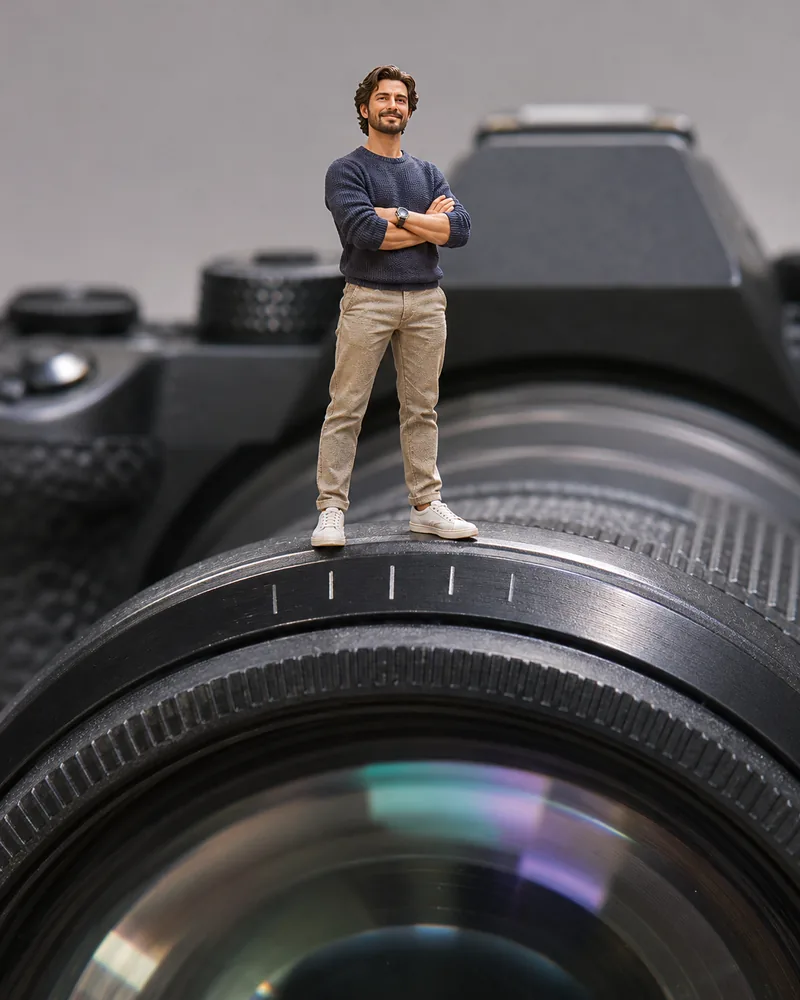
A camera lens works as both platform and subject: its familiar diameter, engraved markings and curved glass make the 3cm figurine look deliberately posed for a miniature product shoot.
Why this prompt works
- Light
- Controlled studio light draws clean highlights around the metal lens rim without washing out engraved focus marks. A larger soft source shapes their face and outfit, while a narrow flag keeps glare off the curved front element so the miniature silhouette remains distinct.
- Lens
- The scene is photographed with a '100mm macro lens at f/5', separate from the 8cm prop lens beneath the person. That focal length preserves facial proportions and the circular platform, while f/5 carries focus from their shoes through the nearest engraved markings.
- Style
- The '3cm tall' miniature figurine on an '8cm wide' camera lens produces a clear product-scale relationship. Crisp anodized metal, optical glass, skin and fabric each need separate textures; controlled reflections make the image premium without turning it into a glossy computer render.
Four one-line variations
Change one of these at a time. If you change several, you will not know which one moved the result.
- Hair colour
- Add 'a narrow warm rim along their uploaded hairstyle' to lift the hair from the dark camera body while keeping its original color and shape.
- Background
- Place the camera on 'a photographer's desk with blurred contact sheets and a small light meter' while keeping the 8cm lens rim dominant.
- Lens
- Change the photographing camera to '85mm macro lens at f/8, slightly elevated product angle' for deeper focus across the figurine and glass.
- Light
- Swap neutral studio light for 'one cool strip light on the metal and one warm softbox on the person' to separate product and portrait surfaces.
When the result goes wrong
- Face warped
- If the camera theme replaces the face with a generic model, add 'exact uploaded facial landmarks, natural eyes and lips, recognizable expression, no helmet or camera mask'. Resolve identity before naming the equipment.
- Plastic skin
- For an artificial finish, specify 'visible skin pores and fabric threads; brushed metal and glass only on the camera'. The renderer needs a strict boundary between the human miniature and the polished product platform.
- Broken hands
- When the pose creates extra digits, use 'one hand resting on their hip, other arm relaxed, five distinct fingers per visible hand'. Avoid touching engraved markings or the curved rim, where overlaps often fuse fingers into metal.
How it compares to Mini Me Desktop Figurine
The desktop figurine uses several small workspace props and a broad walnut surface. This camera-lens setup reduces the composition to one recognizable circular platform with explicit diameter, giving it a cleaner product-photography look and a stronger single scale cue.
See the other prompt