NOTES ON THIS PROMPT
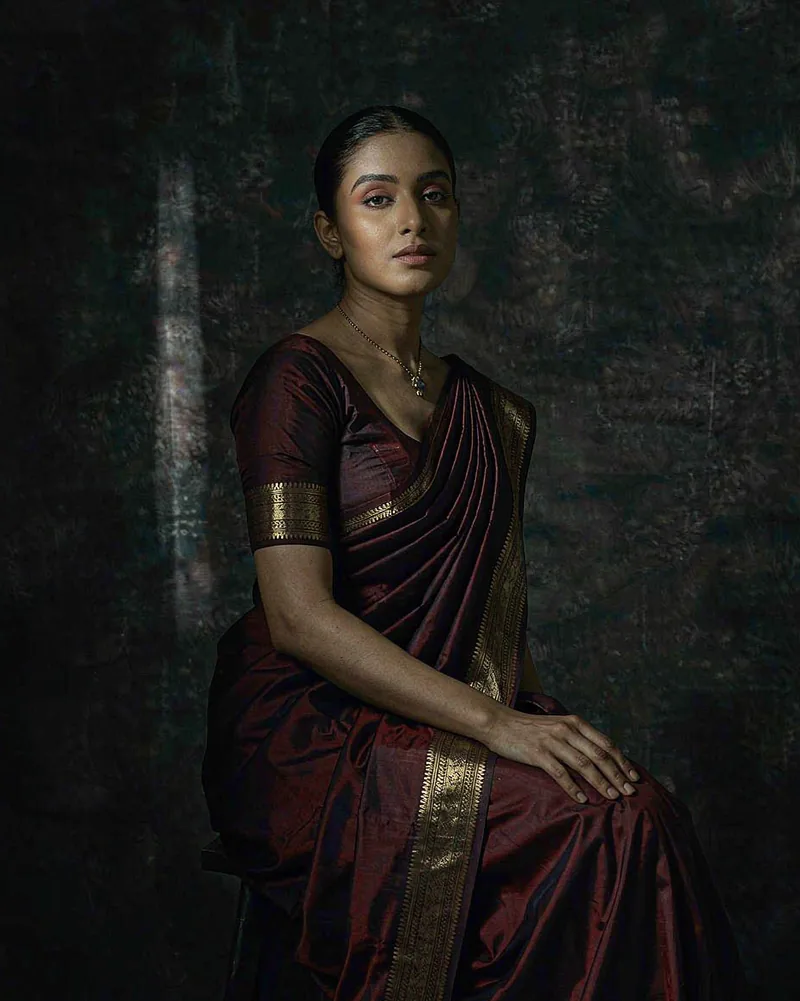
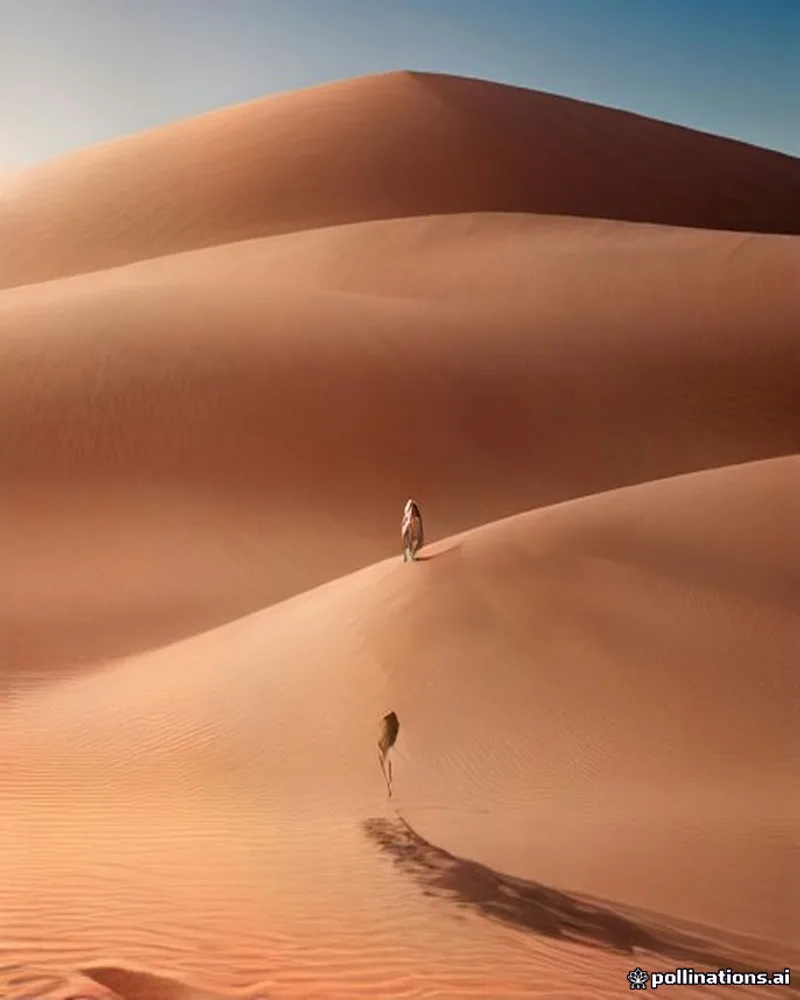
A scale study, not a likeness: a 'tiny figure dwarfed by endless sand ridges' under 'harsh midday sun', with 'negative space dominating the frame'. For fine-art prints, the 'muted terracotta palette' and 'bleached sky with no clouds' are the picture; the woman only gives the emptiness scale.
Why this prompt works
- Light
- 'Harsh midday sun' is the argument. A high, small, hard source throws 'hard-edged shadows' that carve the 'vast orange desert dunes' into light-dark bands, so they read as layered geometry, not a flat wash. 'Bleached sky with no clouds' removes soft fill that might gentle them; no reflector is named, so contrast stays brutal.
- Lens
- '85mm lens at f/5.6 compressing layers' is unusual: a short telephoto stopped down to stack the 'endless sand ridges' into tight bands, not blur them. Deep focus serves 'extremely sharp' and 'large-format photography', keeping ridges crisp. Swap to 35mm at f/1.8 and the dunes sprawl wide and soft - compression and the 'tiny figure dwarfed' effect collapse.
- Style
- 'Minimal fine-art portrait' and 'negative space dominating the frame' set the composition; 'muted terracotta palette' restrains the 'vast orange desert dunes' so the orange stays off postcard saturation. 'Large-format photography' and 'extremely sharp' reinforce each other - fine detail across a big plane, exactly what deep f/5.6 focus delivers. 'Photorealistic' forbids a painterly gradient.
Four one-line variations
Change one of these at a time. If you change several, you will not know which one moved the result.
- Hair colour
- Replace the subject with 'a figure in a black headscarf' so the dark shape reads harder against the 'muted terracotta palette'.
- Background
- Swap 'bleached sky with no clouds' for 'pale dust-haze sky with a low flat cloud bank' and keep 'hard-edged shadows' via the midday sun.
- Lens
- Use '135mm lens at f/8, stronger layer compression' to squeeze the dune ridges even tighter and shrink the figure further.
- Light
- Change 'harsh midday sun' to 'low late-afternoon sun, long raking shadows across the ridges' for a softer, more sculpted dune texture.
When the result goes wrong
- Face warped
- Add 'small but correctly proportioned face, both eyes level, undistorted head' even though the figure is 'tiny'. A distant figure often gets a smudged head, so state proportions rather than enlarge her.
- Plastic skin
- Add 'fine wind-ripple texture on the sand, crisp ridge edges, visible fabric weave, no smoothed gradients'. 'Muted terracotta palette' plus 'negative space' tends to produce flat, airbrushed colour; micro-texture is the corrective.
- Broken hands
- Add 'arms held close, five distinct fingers per hand, no extra digits' if hands show at this scale. Tiny limbs against repetitive ridges fuse easily, so state the digit count up front.
How it compares to Girl Underwater Caustics Portrait
The underwater prompt is cool and diffuse - 'turquoise and aqua color grading', 'rippling caustic light patterns', a '35mm lens in an underwater housing' - this one is hot and hard: 'harsh midday sun', 'hard-edged shadows', an '85mm lens at f/5.6 compressing layers'. One immerses, the other isolates a 'tiny figure' in 'negative space'. Choose the pool for fluid beauty; the dunes for graphic scale.
See the other prompt