NOTES ON THIS PROMPT
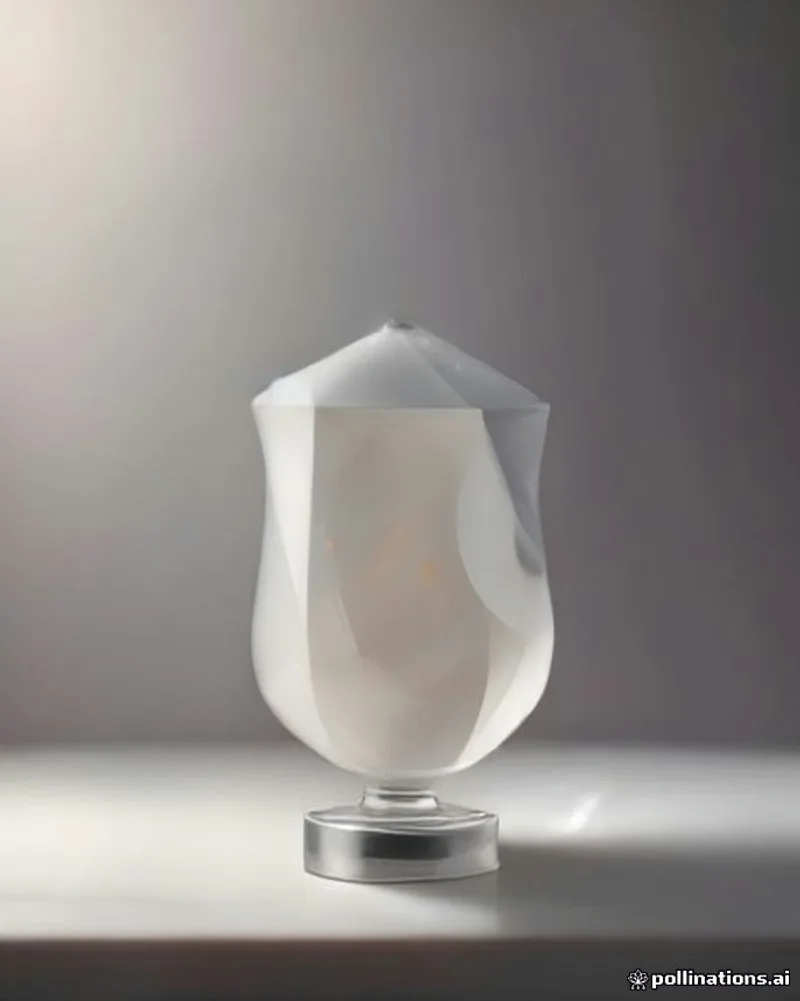
This is a packshot for a fragrance campaign, not a scene: a 'glossy ceramic perfume bottle' sits on a 'mirrored pedestal' while 'floating dried flowers and glass spheres' hover around it. Use it when a client needs a clean luxury product visual with no model, no location, and nothing to date the image.
Why this prompt works
- Light
- 'Soft area light from the top left' is one large source, so the ceramic highlight reads as a single band, not scattered hotspots. Its angle lets the 'mirrored pedestal' bounce a clean reflection back into the bottle. 'Crisp caustic reflections' need that source to keep a defined edge; add a second fill and they dissolve to gray.
- Lens
- The prompt names 'depth of field' but no focal length, a deliberate gap: a virtual camera can stay near-orthographic and hold the whole 'glossy ceramic perfume bottle' sharp. Force a 24mm equivalent and the 'floating dried flowers and glass spheres' stretch at the edges; a 100mm macro would flatten that hover into a stack and blur the front flower.
- Style
- 'Marble and chrome materials' set two reflectance extremes that 'ray tracing' must reconcile: marble swallows light, chrome throws it back, and the 'neutral beige studio background' stops the two fighting a colored surround. 'Octane render' and 'luxury advertising style' demand a clean unbiased path-trace, which is why 'ultra detailed' here means crisp specular edges, not surface grit.
Four one-line variations
Change one of these at a time. If you change several, you will not know which one moved the result.
- Hair colour
- Replace 'glossy ceramic perfume bottle' with 'cobalt blue glazed ceramic perfume bottle', keeping 'crisp caustic reflections' so the new glaze still throws light.
- Background
- Swap 'neutral beige studio background' for 'deep charcoal seamless studio background'; the 'mirrored pedestal' will now return a darker reflection.
- Lens
- Impose '85mm lens at f/5.6, three-quarter view' over the default flat framing; 'depth of field' will soften the rear glass spheres.
- Light
- Change 'soft area light from the top left' to 'narrow strip light from the right', turning 'crisp caustic reflections' into one thin bright line.
When the result goes wrong
- Face warped
- If a face surfaces in the chrome, add 'no reflected faces, no human features, inanimate product only' after 'chrome materials' — the mirror is being misread as a portrait.
- Plastic skin
- Add 'micro surface imperfections, subtle glaze orange peel, faint dust settling on the pedestal' so 'ultra detailed' describes fired ceramic rather than the molded-plastic smoothness renderers default to.
- Broken hands
- If fingers appear among the floating props, add 'no hands, no fingers, only free-floating dried flowers and glass spheres' — the hover is being read as an object someone is holding.
How it compares to 3D Cute Character Render
The Cute Character Render is also an 'octane render', but wraps a vinyl toy in 'studio HDRI lighting with soft global illumination' and 'subtle subsurface scattering'. This still life uses one 'soft area light from the top left' plus 'ray tracing' for hard specular control, with no character. Use that for a mascot; use this when reflections must sell the material.
See the other prompt